Pagans With Disabilities & Chronic Illnesses

Spiritual Accessibility for All

Disability Rights are Human Rights

  • On Ignoring Disability

    Disability is not a thing that is picked up and put down while in the presence of someone. An abled bodied person walks in the room and the disabled don’t say, “Let’s suit up and be disabled now that someone is watching!”
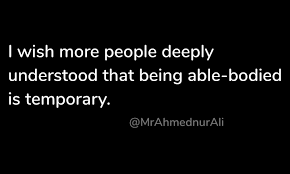
    No, disability by definition and nature is a constant thing. It is something that you live with and struggle with. My husband has often commented that being disabled: navigating insurance, government assistance, doctor’s appointments, and prescriptions; is a full time job. He isn’t wrong. See my article on that aspect of disability.

    Invisible disability is also unique because of the systematic problems that it creates. I have a diabetic friend who has battled for sometime with a sore on his foot. It necessitates IV antibiotics which requires a pic line which requires regular breaks at work and home to take the IV antibiotics. His diabetes is well managed. This is just a side quest on the larger quest of dealing with diabetes. His simple limp doesn’t really expose the breadth and depth of his challenges. Because we live in an ableist society, keeping his job relies on looking abled bodied.

    When you struggle with an autoimmune disorder the problem grows exponentially. Autoimmune disorders causes the whole body to work in unexpected and wacky ways. Yes, wacky. Your body doesn’t feel like it belongs to you. Your body is completely out of your control.

    My sister has an autoimmune disorder. She is undiagnosed because of poor health care and limited funds. She hasn’t been able to drive for months because her right foot has just chosen to go numb. From her hip to her foot, she has excruciating pain and then her foot itself is numb more often than not. This has amped up her stress which in response has amped up the pain in her hip, leg, and foot causing the cycle to continue on viciously.

    Those of us with autoimmune disabilities understand on a deep level the ways in which our bodies systems are connected and stress’s effect on the body.

    This also leads to our inability to work regularly. My sister has been working remotely for some time by doctor’s orders because she cannot drive. I go through times of great out put in my life and those are followed by times of equally great inability to put out any type of work whatsoever. She is constantly compared by her abled bodied boss to people who are abled bodied and quickly recover from injury. It doesn’t cross her boss’s mind that her condition is chronic and severe all the time.

    I struggle deeply with consistency in my life. What I am able to do one day I will be completely unable to do the next day. Goddess forbid you put a common cold or other infection in the mix, then everything is shot to hell and gone.

    This is why it is hard to “spot a disabled person.” When the physical disability is easy to see (missing arms and legs, confined to a wheel chair) then it is easy for the abled bodied to sympathize. When you deal with a chronically disabled person you often see them at their best, because they hide away at their worse. There is so much inherent shame that an ableist society creates around being sick in the first place. Those of us who are chronically ill learn to hide, mask, and pretend that we are all good. Even my ability to put this article in most abled bodied human’s mind means that I am clearly abled bodied.

    What you don’t see is the real struggle to get out of bed because sleep wasn’t good. Struggle with eating healthily versus eating what ever you want. Exercising versus not being able to in mind or body. Taking tons of herbs and vitamins in an attempt to undo the damage being done to your body on a second by second basis. We smile over pain knowing we have a threshold for pain most can’t conceive.

    One of partner’s was in the hospital recently and they kept asking how her pain was. I sympathized with her exasperation. Pain is a every day thing, asking if the specefic pain at the current site of acute illness is better is one thing, but asking if the pain in general is gone is just silly. She would say, “It is much better,”

    “Great!” the doctor would say, “So it is gone.”

    “No,” my partner would hedge, “It is much better.”

    “Well, what’s your pain number?” the doctor would respond.

    My partner knowing that continued hospitalization was on the line would hedge, “It is, ya know, like a five or so.”

    The doctor’s never knew what to do with that. I finally stepped in and said, “This pain, the urgent pain is much better and getting better, is what she means.” Grateful, she would smile and nod.

    Most doctors are abled bodied and for them, you are in pain or you are not in pain. There is no place where you just live with your pain. And yet, their patients do it every day, simply live with the pain and discomfort. Go on about their lives despite the struggle.

    I expect a certain amount of pain in my life. Acute pain is alarming as it is for everyone. It doesn’t, however, mean the same thing for the chronically disabled as it does for the abled bodied. We can have grave pain and address it and move on. I have learned tricks to do just this. (a tens unit on hand at all times, for example, or preemptive pain medication). I see a chiropractor because I have that privilege I also arrange my life so that I can rest before times of great physical exertion. I have that privilege, also. Parking in the handicap spot.

    Life is about finding a way to navigate and over come whatever your difficulties are. The more privileges you have the easier it is to navigate those challenges. I have a ton of privileges. I financially married well. We have insurance. I don’t *have* to work to make ends meet. Because I have superior health care I am better able to manage my disorders. I have the added benefit of a service dog. I can afford helpful and sometimes necessary vitamins and herbs. I have time to fight for my needs and find alternative solutions to uncovered medications.

    Yet the thing I can’t over come is the inherent disregard of the abled bodied society. I am seen as a high functioning invisible disability person. You can’t look at me and tell I am sick. To this end I have been compared to persons born without arms and legs as if that is somehow the gold standard in disability – only disabilities you see count, my invisible disability isn’t as real or as impactful as living without arms and legs. Yet it is and is not. I have so many privileges others do not have to battle my chronic illness. I sometimes am struck dumb by what others with similar issues must do in spite of how they feel or what their bodies are capable of.

    Recently, my therapist asked what I did for my chronic illness in times of necessity and high stress.

    “Ignore it,” I responded without hesitation.
    And that is what most with chronic and invisible disability do every day to survive.

    I wish for a world where the world no longer ignores the ableist privilege that is pervasive and at times more damaging than the already daunting world those with disability face.
  • The Cost of Healthcare Isn’t Just What you Think

    Healthcare is expensive there is no denying that. But for the disabled and chronically ill there is a hidden expenses the abled bodied never consider.

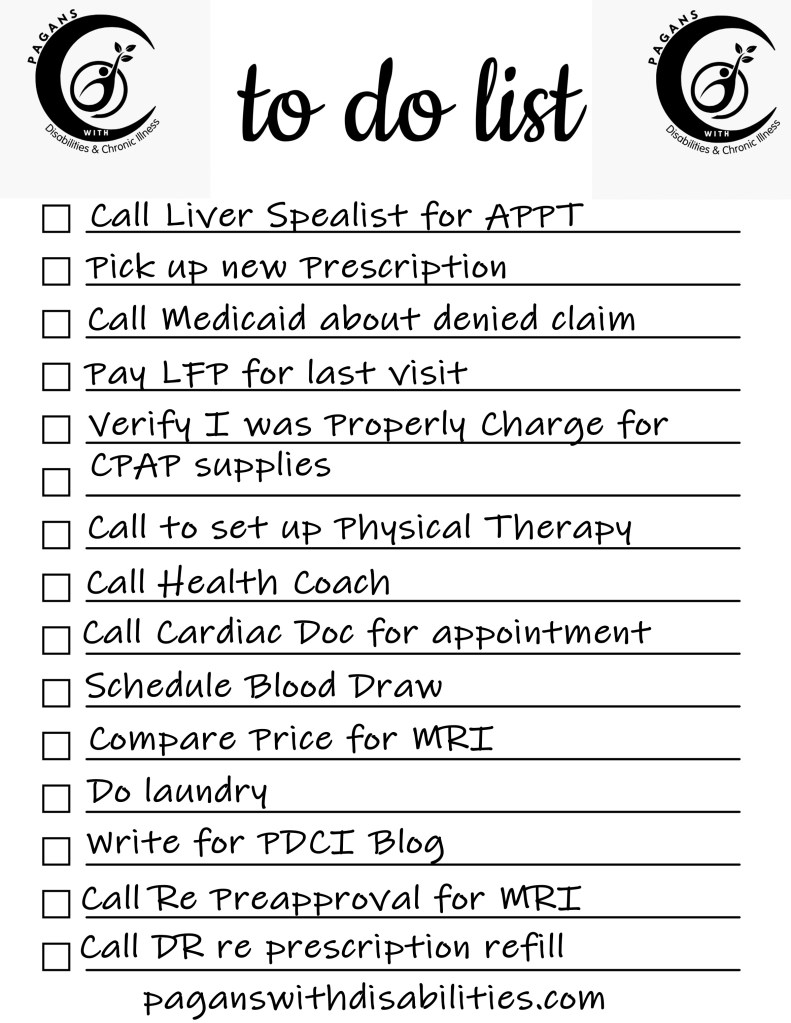
    To do list with medical action items.

    I started journaling again this year and looking back on the year so far, what struck me was the number of to do or done items on my daily lists that involved doctors, pharmacies (yes plural), insurance companies (again plural), and other healthcare advisors and assistance I call on a regular basis. I decided to add up my time and give some numbers to the plight of the disabled and chronically ill.

    This week I figured I spent about 8 hours on the phone or on the internet trying to wrangle and figure out my new insurance and ensure that all my current medications will be covered. They won’t be which led to another time suck of trying to determine how to afford these medications without insurance covering. By the way, today is Thursday, I still have another two days to go and spent an hour just this morning on a health related call.

    When people ask me what the disabled do… we manage our conditions, doctors appointments, and insurance (if we are lucky enough to have it), trying to ensure our needs are met. When I worked part time, I demanded Tuesdays and Thursdays off so that I could have dedicated days to go to doctors appointments and tend the business of being sick. For it is a $129 billion a year business, that is in profit folks. Because I am on Social Security, I have to track my out of pocket expenses related to my illnesses.

    Because I track how much money my family spends out of pocket I can reliably tell you the costs for my family since 2022 when I started keeping detailed records.

    YEARAnnual Out of Pocket Costs
    2022*$8,329.35
    2023$10,658.75**
    2024$8,781.82
    2025$10,045.16
    2026 Year to Date$1,154.96
    *2022 I didn’t start calculating until March **2023 I partially paid for a service dog but 2025 is simply inflation.

    For those not keep track that is an out of pocket cost for my medical expense of $38, 970.04 in less than 5 years. I worked for 3 of those years a part time job and my working barely paid for my out of pocket expenses. The costs would have been substantially more if I didn’t also have Medicaid.

    Now before you get up in arms about this and argue that I take a pay from my SSI benefits. I would tell you, yes that is true. I’ve estimated my take home pay from SSI after taxes and I pay for Medicare Part A & B (which does not include a prescription health benefit). I roughly brought in $44,300 in the same time period. That does leave me a whopping $5, 329.96 to live on. That would work out to about $153.05 per month. Luckily I married an abled bodied man with a job and good insurance or I would be destitute. Who can live on $153.05 per month? Or I would make choices that would negatively impact my health – have a place to live or get my healthcare taken care of. Eat or get prescriptions.

    What about people who aren’t on disability, don’t have insurance or are under insured, and don’t have Medicare or Medicaid? They go without. Without being diagnosed properly or without proper treatment if they get a diagnosis. They simply suffer. I am not being dramatic here, I am being pragmatic. It is simple fact.

    But that isn’t the hidden cost my title refers to. If we figure that I spend 6 hours per week working at the business of being sick (going to doctor’s appointments, negotiating with Medicaid and the insurance company, picking up prescriptions, fighting denied claims, and paying medical bills. That is 1,104 hours at my last rate of pay, $18 an hour, we can add an additional $19, 872 to the cost of my being disabled and ill. Now we are up to a cost of $58,842.04 to be sick in the United States over less than a five year period. That puts me right below the estimated cost needed for an adult who can work and is disabled. Of course if I could find a part time job that actually pays what my education and background before I was sick was worth that price estimate would be much higher.

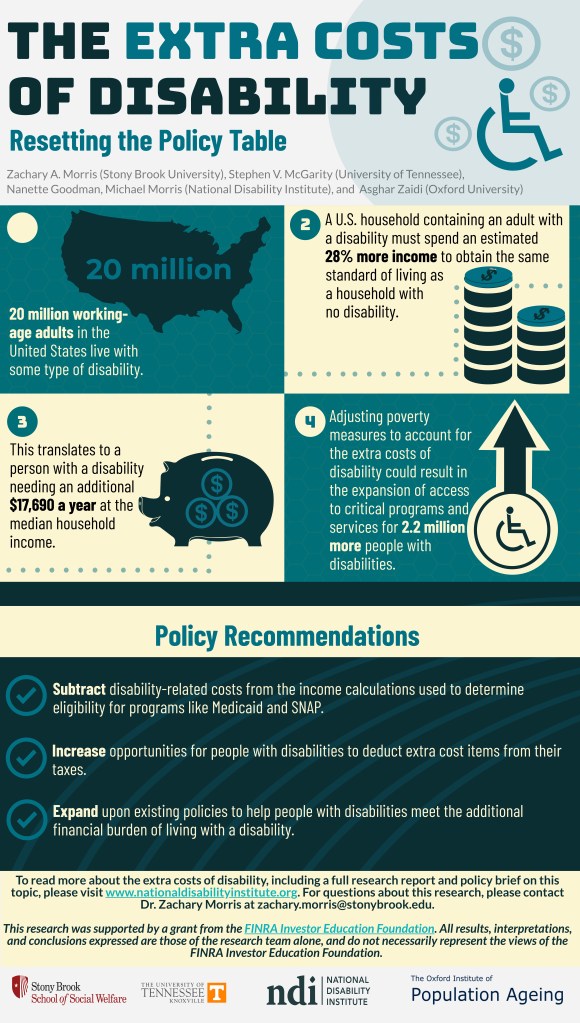
    Researchers estimate that households containing an adult with a work-disability require, on average, 28 percent more income (or an additional $17,690 a year for a household at the median income level) to obtain the same standard of living as a comparable household without a member with a disability says the National Disability Institute.

    And I currently do not work because part time jobs that are within my ability to accomplish are few and far between. It took me two years to get my last part time job.

    The National Disability Institute set forth some good suggestions of policy changes that would allievate this strain on persons who are disabled and their families. (See their graphic below.)

    All I can say to add to this is, I have phone calls to make.

  • Light a Candle for Me?

    I have a good friend who has been hospitalized. I went into my coven’s Discord to post about her condition and ask for energy and prayers. I found myself dissatisfied with what to request: Light a candle? Pray for healing? Pray for wellness? Pray for a resolution to the current issue? Pray for a definitive diagnosis with a known solution? I was left stumped about how to move forward.

    This angst comes from the belief that what we think about manifests and is tied to the Axioms of Magic. These “laws” are meant to explain and describe how magick (or more precisely, energy) works. The Axioms at play in the act of healing are the Law of Association and the Law of Contagion.

    The Law of Association says that if A and B have something in common then that thing in common can be used to influence both A and B. Further B can influence A and A can influence B. Additionally, cause and effect have resonance with each other (the Law of Similarity). After you bring things into contact with each other, they will continue to affect each other after separation.

    In my example, my friend is A and energy sent to them is B. The thing they have in common is that energy is a universal entity that is always having an effect on the Universe and my friend. Once the energy has been brought to bare on my friend it continues to act upon my friend even after the person who initiated this energy stops sending it.

    This is important in illness because if that energy is not quantified, it is just energy with an unknown effect on my friend’s body. Is this positive or negative? Can my friend’s body handle more undirected energy in her body or does that energetic excitement cause her to have a higher likelihood of infection or abnormal growth of cells?

    Other Axioms at play are the Laws of Words or Symbols of Power, The Law of Labeling, and the Law of Knowledge.

    The Law of Words says, in short, words have power; what we say and how we say it has an effect upon the Universe, and in this example, a person. The Law of Labeling says that when you label a thing, you exclude information from that thing. In this case, labeling my friend as ill, which is true, magically disallows the idea of “well” from them. Lastly is the Law of Knowledge, which says the more you know about a thing, the more power you can exert over that thing. The problem here is that medicine is an art – an art informed by science but an art nonetheless. The Doctors have a guess about what is causing my friend to be hospitalized but they cannot say for certain what is wrong. They know her symptoms and can quantify those, but the cause, as is often the case with persons with autoimmune disorders, can remain a mystery. The ability to KNOW concretely what is wrong with my friend may be beyond our reach.

    Does it track then that we cannot affect some positive change in her condition by lighting candles and sending energy? What should the request be in that moment? How can we quantify it to have the most beneficial result?

    Typically, that is simply, “Please light a candle for my friend.” I would argue, however, that that just sends random energy into the Universe at best. At worse it sends undirected energy to my friend who is in no condition to process and utilize energy in her weakened physical condition.

    Hence my conundrum.

    I think when we generically ask for energy, we aren’t being specific enough to get specific results. The great Janice Farrar taught me that healing magic works best when it is specefic and everyone is specifically focused on the same thing. Our Coven had an opportunity to try this that same year and was wildly successful keeping the side effects of chemotherapy from running amok in a covener.

    However, letting everyone know the intimate information about your physical condition may not be something you want to do. If you have enemies, it gives them an opportunity to be very specific about harmful uses of the Axioms of Magic. This can be safer in covens with oaths that protect membership. However, as open as I am about my physical conditions, there is always information I hold back to protect myself.

    After some thought, I think it is better if you can ask for specific, visualized outcomes. If you are the sender to a generic request for good thoughts, try sending the energy to be used to the best and highest good of the person you are thinking about. Or to the doctors around the patient, that they make the right decisions to lead the patient back to optimum health. The more specific you can be, the better the results will be.

    Now I suppose I should write another blog about why adding the caveat “and it harm none” is not a good one when the goal is optimum healing.

  • New Year’s Resolutions?

    Disability Rights are Human Rights

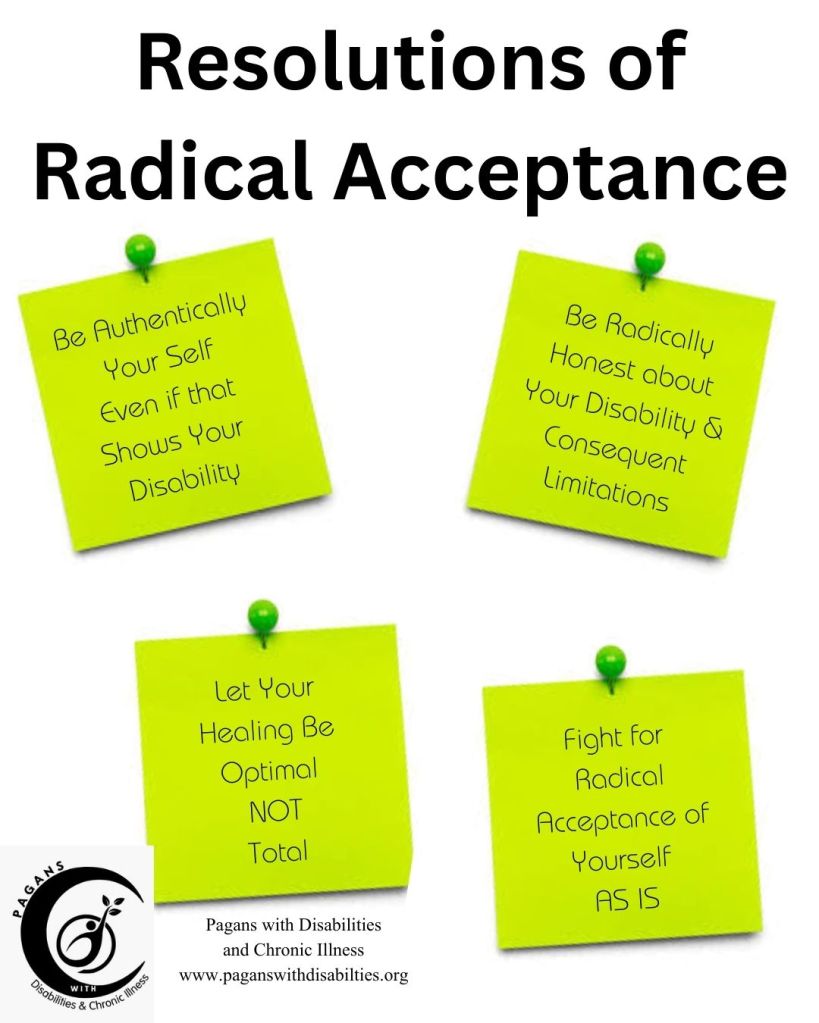
    This is typically the time of New Year’s Resolutions. New Year’s Resolutions can often feel imposed upon us and restraining. Nearly always around diet, health goals (working out more), and in some way changing who we are.

    What if our New Year’s Resolution revolved around acceptance. Radical acceptance a description of who we are and where we are at? This type of acceptance is especially important for persons with disability. I am going to encourage you to either focus your resolutions on acceptance of your self, your health, and your life AS IS.

    Most of us don’t want our disability to define us and our capabilities. So we push – often too hard – and in doing so are worse off. I haven’t met a disabled person yet who is lazy and unmotivated. We have to be motivated. We have to find a way to do things that everyone else takes for granted. We figure it out with typically less resources and support than our abled bodied counterparts.

    In order to do anything productive in our lives, as a disabled person, we must always be striving and reaching and overcoming. We can’t stop or slow down or the illness or disability will define us and shackle us to less than we want to and hope to be.

    Most disabled persons are overachievers, but their achievements aren’t recognized or acknowledged because they succeed at “passing” as not disabled. So the achievements and obstacles that have been overcome are relegated to “not that bad” or “not that hard” regardless of how much stress and strain is created in appearing “normal.”

    What if the disabled said, “FUCK THAT,” and radically started advocating for our needs. What if that was our New Year’s Resolution?

    Instead of saying, “No I can’t do that.,” expose the truth and say instead, “No, I can’t do that because I am limited by the disability I have.” Or when someone asks how they can help, we actually ask for the help we need. We use a language other’s need to learn. “I can’t do XYZ because I am out of tokens (or spoons).”

    Make people come to have an understanding of the struggle in real time that the disabled face and overcome or need to pass on in order to make it through.

    My best friend is disabled and when she was looking for a job she was very forthright about her disabilities and limitations. I thought she was crazy. Eventually, she landed a great job that has accommodated her challenges and set backs caused by her many disabilities. I am not saying it is the greatest of situations. I am saying because of her bold decisions on the front end she can start all conversations with, “Before you hired me I told you about my disabilities and limitations; .and you said you would accommodate and work with those.”

    What a radical way to live. As our gay and lesbian sisters have done, those of us, especially with disabilities not easily recognized, need to come out of the medical closet and step into society as our radical selves. We need to find ways to incorporate this radical acceptance of ourselves and our limitations into conversations with the abled bodied world. We need to be a bit more vulnerable in our presentation in order to make the point…. disability rights are human rights.

    It won’t be easy or even readily accepted, and we must start somewhere. Radical acceptance and living is a good place to start.

  • How an Ableist Society Affects You

    Our attitudes towards persons with disabilities and chronic illnesses are informed by the society we are a part of.

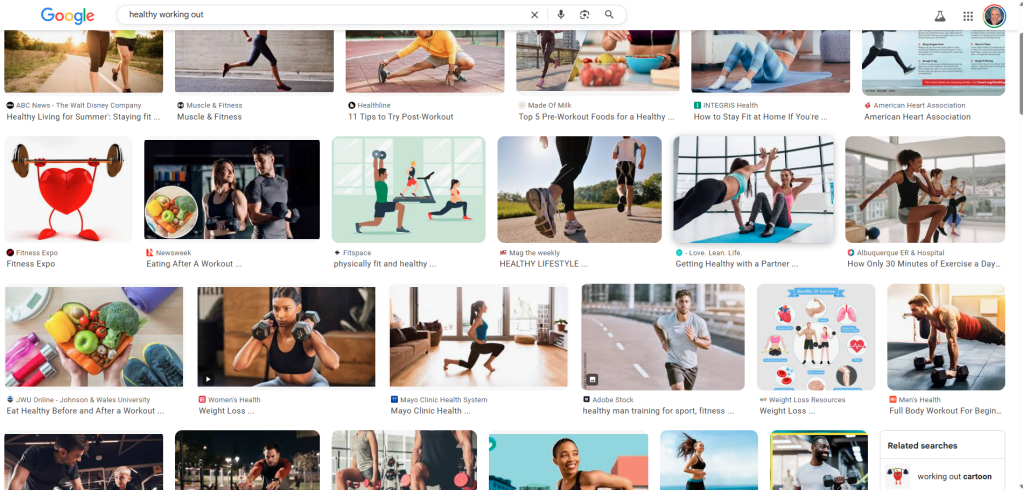
    Put in healthy into Google and images of healthy foods are interspersed by very thin models eating healthy food. Put in working out and you get nothing but able bodies running, exercising, lifting weights, and the like. All abled body.

    There is a not so subtle message at play:

    healthy is defined by a certain weight and physical capabilities.

    There isn’t a normal average-weight person to be found in the first seven rows of pictures and graphics under working out. Even the cartoon people are in good shape. They certainly aren’t thinking about this guy. (I apologize I can’t embed this video but is worth clicking on.)

    A lot of this has to do with the advertising industry’s unwillingness to boost the signal of the disabled and chronically ill, the guy above notwithstanding. A lot has to do with the pharmaceutical sector benefiting from pushing the ideal weight as some uniform number that we can all obtain and strive for.

    Your attitudes about the wellness and well-being of others are informed by the advertising, medical, and pharmaceutical sectors. You are a mental patsy. Spitting back dogmatic views about health and wellness that are interfering with your capacity to be compassionate and loving to other body types and capabilities.

    This is why you wonder if the person who is overweight couldn’t just improve their circumstances with a diet and some exercise instead of wondering if their thyroid is broken or that a healthy weight for them is different than a healthy weight for you. We see healthy foods and wonder why people can’t just eat better when junk foods cost less than vegetables and healthy proteins. We don’t think about the statistic that 25% of low-income people live with disability (as compared to 12% in other income brackets, staista.com, accessed in April 2023. Making them at a disadvantage when it comes to getting into a grocery store with vegetables and healthy proteins, much less being able to afford healthy foods. Run down to your local food pantry and see how much produce is available. Typically, none. But cheap Ramen, cookies, and candy are plentiful because they are cheap and have a long shelf life.

    Where there is a will, you say, there is a way. This, too, is part of the usually unattainable standards set by society to blame the victims of poverty, injury, and illness for their lot in life. Instead of holding society responsible for ministering to the “least of these” (Matthew 25:40).

    If you are okay with these societal attitudes, I encourage you to let your thoughts and actions towards others remain unchallenged. Or you could start questioning whether your highest self has shown up or if it is the programming that society has given to you. You could actively involve yourself in not judging people who ask or need accommodations. You could actively participate in self editing your thoughts when they come up as judgmental. When someone is hurt you could show compassion instead of having a, “Suck it up,” attitude.

    Most importantly you can remember that your body is yours and their body is theirs.

    It is called Bodily Autonomy, the right to make decisions about one’s own body, life, and future without coercion or external interference. Yet you don’t mind being coercive or judgmental and sometimes even mean. You want to cry bodily autonomy when it comes to significant issues like choice, contraceptives, and the right to healthcare. It just seems a step too far to say that weight is also a choice that bodily autonomy guarantees. Yet somehow, if their weight isn’t societally acceptable, then it is okay to judge someone as lazy, unmotivated, and undisciplined. Which is also an arbitrary rate based on some normalized standard by industries with billions to gain by enforcing these views of health and beauty.

    Those of us who are disabled and chronically ill don’t have bodily autonomy. We are at the whims of a body that is coercing and interfering. We are restricted and restrained by wear and tear, traumatic injury, and broken DNA. Often, our disease is beyond the realm of cure. Our bodies are slowed down by disease and injury, and medications have far-reaching side effects that sometimes are as bad if not worse than, the disease or injury itself: addiction, weight gain or loss, arthritis, nausea, diarrhea, and random pain. Often all of this is unable to be detected by the outside world, by you.

    Yet you have all the reasons in the world to judge and interfere. Ask “what if” questions as if the person who has been injured or is ill hasn’t thought about any alternative to relieve a portion of their suffering. Or a judge based on weight or physical capability, limiting the access and support needed to do simple tasks.

    You could be a powerful advocate for change by simply monitoring your thoughts and judgments. Or you can continue to be a mental pasty for societal views that are outdated, antiquated, unhelpful, and unkind. The choice is yours.

    Here are some phrases that you unknowingly use that are considered ableist.

    Cripplingly/crippled by/a crippling degree of ______

    Your acting bipolar, What a schizo, ect.

    I’m so [insert disability here] when you are not

    Fall on deaf ears, turn a blind eye, ect.

    You don’t LOOK disabled.

    Wheelchair-bound/confined to a wheelchair

    Suffer from/handicapped by [insert disability here]

    You’re such an inspiration!

    For further context: read this article from Drew Dakessian about Ableist Language & Phrases That You May Unknowingly Use

  • Working Disability and Chronic Illness Definition

    Disability can be defined as any physical or mental condition, sometimes resulting from an accident, injury, or illness, that interacts with societal barriers. Disability is an inability to perform some (or all) tasks considered common everyday activities without changes to those tasks or the environment.

    Chronic Illness can be defined as a physical or mental condition that is caused by an underlying medical condition that may interact with social barriers. Chronic illness leads to an inability to perform some (or all) tasks considered common everyday activities without changes to those tasks or the environment. Chronic Illness and Disability do not need to be readily apparent to exist. Not all disability or chronic illness are visible.

  • Attitude of Total Healing versus Optimum Healing

    For many years the pagan community has had an attitude of total healing. Someone is sick and Pagans line up to bring total healing or restoration to a fully functioning body.

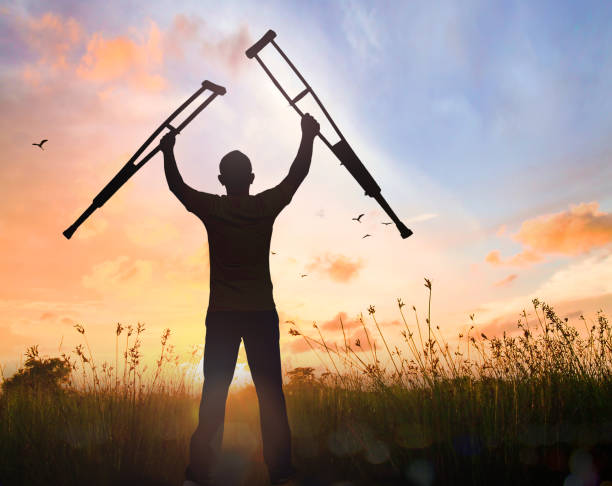
    Silhouette a disabled man standing up and raising his crutches at meadow autumn sunset background

    It reminds me of a time when I was still not clear about the autoimmune disorder that I suffered from. I was at a festival, feeling tired and generally very sick. A healer there, very well intentioned, told me to come to her camp. She laid me on the ground and she did a chakra aura cleansing with rocks and minerals on my chakra points. I didn’t feel anything significant at the time. But a few hours later, I was throwing up and much worse than I had been. By the end of the weekend, I was in a hospital getting my appendix and my gall bladder removed. I feel this healing session did what was intended: tried to heal my body back to total health.

    There seems to be an assumption about what “healing” looks like—a restoration to a fully functioning body. My body, in a weakened condition, ejected my appendix and gall bladder when faced with the goal to restore my body to a totally healthy state, a state prohibited by DNA strands that had been altered by my Chronic Post Traumatic Stress Disorder.

    Years later at the Parliament for the Worlds Religions I ran into another healer. This one was going on and on about a healing class they had just taken. He said, “If we could get people to just think themselves well and that their mind has that power…..”

    “What,” I responded, “If their DNA is broken. Can they think their DNA back to “wellness?””

    He stood looking at me while I watched his mind slowly digest what I had really asked. Can you physically, mentally, and psychically think yourself well if the illness is generated at a DNA level?

    This healer didn’t have a ready response and chose to disengage by walking away.

    To further complicate matters, when total healing is an attitude pushed by healers, it is rooted in a very ableist mindset. The idea that wellness only equals total healing leaves an entire spectrum of healing untapped. And leads those with illness to feel that anything less than total healing is a mental, spiritual, or psychic failing.

    I do believe in the power of the mind to heal, but I don’t think we can overcome all illnesses just by thinking about it. It is like global pollution. We can harness psychic energy to heal the Earth, but if we don’t stop polluting, the Earth will only improve so much with our good thoughts, well wishes, and magic. And to take the metaphor further, not only do we know how NOT to pollute the Earth (less fossil fuels, less garbage, less coal), we also know how to generate wellness in the earth (electric cars, recycling, alternative energy). No one believes that the Earth will ever be free of the effects of human pollution. Even if humans are eliminated, our impact on the Earth will remain.

    There needs to be a shift from the belief that healing is the traditional concept of no illness, everything functioning wholly, to an optimum healing for an individual. What I meant by this is best demonstrated by a Big Named Pagan who taught my coven the Chalice In Drinking of Wellness ritual. A group centers itself around the person who is sick. The coven chalice is passed person to person to be charged with a purpose, and then the person who is sick drinks everything in the chalice, drinking in the energy that was raised. We were explicitly taught not to center our energy on “healing” but on specific wellness goals. If someone has cancer and is going through chemotherapy, then you focus on easing the effects of chemotherapy, not on the cancer being gone. In this manner, a member of our coven had little to no chemotherapy effects like vomiting and significant fatigue. The cancer resolved, and she has been cancer-free since. However, our coven didn’t focus on beating cancer, we focused on the more immediate need of the individual’s health journey.

    In the case of cancer, there is a beginning, middle, and end of the effect of illness, but what if someone has Ehlers-Danlos, MS, a POTS disorder, or other genetically created autoimmune disorder? When working on “healing” for these types of illnesses, is it reasonable to focus on healing as a return to traditional views of health with no sign of disease at all?

    The focus of our healing should be to return the body to what would be an optimum healthy state for each individual. This might not be a traditional view of health as being free of any sign of disease. It might mean a decrease in inflammation in the body, a stabilization of blood pressure, or a decrease in the body pain. These actionable items are more concrete and more likely to have a positive impact on the person who is ill without the added stress of feeling that healing must be complete and total.

    A good example of this is chronic post-traumatic stress disorder. This chronic condition does not respond well to the idea of a return to the physical state of the body before the traumatic episode happened. Largely because trauma cannot be forgotten, it only can have a reduction on its impact of the body. C-PTSD has been shown to have an effect on the DNA in a body. It also has an impact on telomeres. Telomeres are the protective caps at the end of chromosomes, made of DNA and protein. Telomeres prevent the chromosomes from fraying or fusing together and protect the genetic information within the DNA strand. The more damage and excessively shortened telomeres become, the greater the cellular aging and the more disease. (page 87, The Deepest Well, Nadine Burke Harris, M.D.)

    Telomeres have been proven to respond to exercise, diet, and meditation. The longer the telomeres, the more improved a chronic condition is. (page 88, The Deepest Well, Nadine Burke Harris, M.D.). Consequently, this is an avenue for energetic healing. Focusing on lengthening and strengthening telomeres can improve chronic conditions. This is an example of optimum healing.

    There is no striving to restore the body to a pre-trauma condition; there is an active working on the actual mechanisms in the body that will promote better health for the individual.

    Optimum healing is the best outcome within the confines of DNA damage that has already been done. It is the idea that healing doesn’t mean a cessation of all illness. It can mean an easing of symptoms. This idea is also free from ableist thinking, which is in and of itself a whole blog post.

  • Passion of Acceptance

    I started Pagans with Disabilities and Chronic Illnesses in the hopes of giving the disabled a voice when talks of pagan events happen. A way for those with disability to provide suggestions about the best practices when hosting pagan events.

    I have heard that you can’t negotiate for what you need if you do not have a seat at the table. Often, the disabled have no one to speak on their behalf when plans for pagan events happen. This usually means that the needs of the disabled, chronically ill, neurodivergent, and those challenged by mental health are not thought about when plans for an event are made.

    We are currently running a questionnaire seeking points about the good and bad practices people have encountered while trying to participate in the larger pagan community. We are also interested in how disability, chronic illness, neurodivergence, and mental health impact how you practice your pagan spirituality. You can fill out this survey here.

  • Just Getting Started

    This is an ongoing process to start a resource for pagan groups and practitioners wishing to be inclusive to the disabled and chronically ill. If you want to help in this effort, please join our Facebook Group here.