My husband has a dog name Ziek. Recently, we have been battling a leg repair Ziek had in 2025. He is predisposed because of his genetics to have a torn Cranial Cruciate Ligament (CCL). This essential part of his leg helps stabilize Ziek and helps him walk. Without it properly working, he limps badly and can be in excruciating pain. There are two types of surgeries to correct this issue and neither are cheap. But we had been through a torn CCL before and the repair has done wonderfully. So despite his age (12 years), we decided to have the CCL repaired by the same surgeon who did the first. This started a journey of illness for Ziek that has lasted months.
He had the repair and things went well for a few months until he developed a severe infection in the leg with the most recent repair. The repair uses sutures within the leg to attach ligament to the bone to repair the tear. Over time scar tissue builds up and the leg gets progressively better. The infection took 1 month to resolve and we thought we were out of the woods. The infection, however, returned. So we decided to take him back to the surgeon for his opinion.
The surgeon took one look and said that Ziek’s body was rejecting the suture and treating it as a foreign body causing the infections. In short, the suture had to be removed which meant another surgery. Luckily the surgeon said he would perform the surgery for free because “This is no one’s fault. You can’t tell if the suture is going to be rejected. It was nothing to do with your care. It was nothing to do with the dog. It just happens sometimes.”
Given this information, we went ahead and agreed to the second surgery in less than 6 months to remove the suture. This started a search for a better cone to prevent him from licking incessantly on the new wound area.
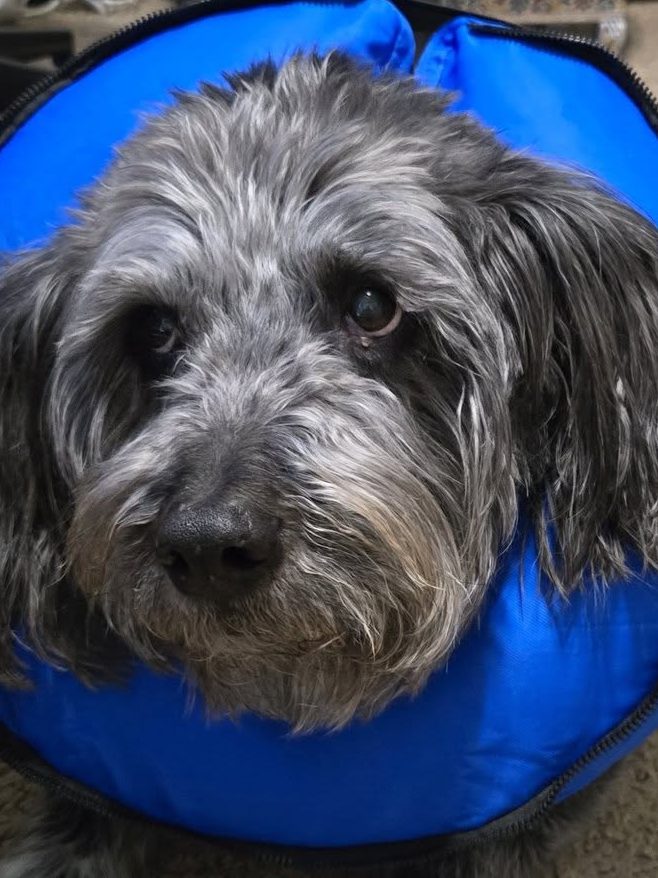
We got him this cute donut that had an attachable cone option and found it to be far superior to the big plastic cones doctors offices typically give out.
Yesterday we were walking Ziek and a neighbor saw, greeted, and asked us, “What did he do to earn the cone of shame?” while pointing at Ziek.
The exchange gave me pause. Ziek had done nothing. We had done nothing. He isn’t in charge of his genetics. He didn’t ask to have bad CCLs in both back legs. He didn’t ask for his body to reject the treatment from the first surgery. He didn’t ask for the infections. We didn’t fall down on his care.
Still the Ableist Society says, “What did Ziek do to earn the cone of shame?”
The problem with this is that it blames the patient for illness or disability. This is a great example of what persons with a history of chronic illness or other physical limitations face. What did you do to earn your metaphorical cone of shame – the handicap parking plate, the cane you need to walk, the service animal that is essential to your continued good health.
What did you do?
This allows for society to focus on blaming and holding the disabled responsibile for things out of their control.
Recently, a friend couldn’t attend an event because of her on going medical problems, the event coordinators said, “Come anyway. We will take care of you.”
For an Able Bodied Person this seems like a reasonable assertion. It down plays the seriousness of a chronic illness and puts the onus on the person with the disability. If they would dig deeper it will be fine. This same group gets upset when someone attends and then needs external intervention. If they were that sick why didn’t they stay home? This makes the audacity in telling a chronically ill person that they can “Take care of” the disabled even more outrageous. Forget the fact that they couldn’t even tell my friend how they would meet her unique challenges and needs.
Because they can’t fathom a physical alignment that can’t be overcome. Surely my friend exaggerates her needs and once on site the needs would simply disappear. It is this attitude that prevents organizations from offering accommodations for the disabled. If accommodations are needed, then the person must be too sick to join in and be of value to community. This all or nothing attitude is reflected in my dog’s “Cone of shame.” Ziek did something bad or he wouldn’t require the cone.
We can affect some change in the ablest society by simply changing our perspective on something as simple as a dog’s cone. If we can learn to remind ourselves the dogs and cats don’t “earn” the need for a cone, we can begin to undo the ablest views of the disabled.
Further, we need to get rid of the term, “Cone of Shame” because it infers the dog or cat has done something that requires the cone. This makes it easier to blame and have unreasonable expectations of people who need accommodations.
So the next time your pet has reason to have a cone, just don’t add “of shame” to the identification of the cone. Practice understanding that the dog and cat didn’t ask for their situation any more than the disabled and chronically ill can control the situations that have lead to chronic illness and disability.
 Pagans With Disabilities & Chronic Illnesses
Leave a comment