
Healthcare is expensive there is no denying that. But for the disabled and chronically ill there is a hidden expenses the abled bodied never consider.
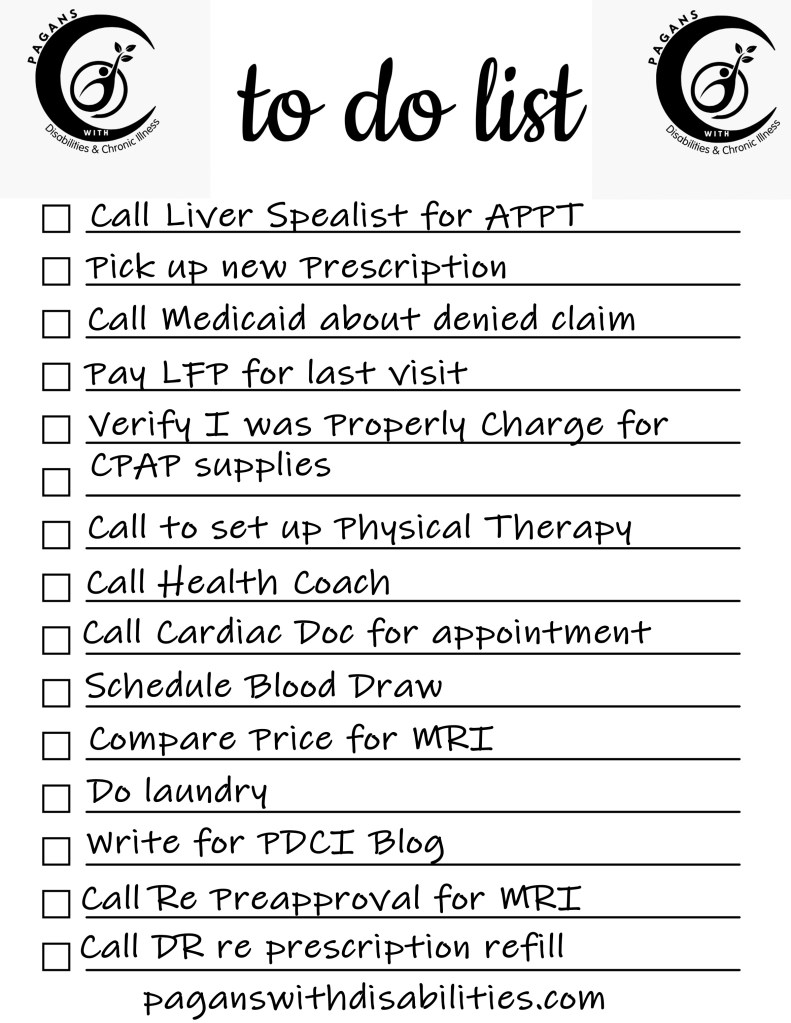
I started journaling again this year and looking back on the year so far, what struck me was the number of to do or done items on my daily lists that involved doctors, pharmacies (yes plural), insurance companies (again plural), and other healthcare advisors and assistance I call on a regular basis. I decided to add up my time and give some numbers to the plight of the disabled and chronically ill.
This week I figured I spent about 8 hours on the phone or on the internet trying to wrangle and figure out my new insurance and ensure that all my current medications will be covered. They won’t be which led to another time suck of trying to determine how to afford these medications without insurance covering. By the way, today is Thursday, I still have another two days to go and spent an hour just this morning on a health related call.
When people ask me what the disabled do… we manage our conditions, doctors appointments, and insurance (if we are lucky enough to have it), trying to ensure our needs are met. When I worked part time, I demanded Tuesdays and Thursdays off so that I could have dedicated days to go to doctors appointments and tend the business of being sick. For it is a $129 billion a year business, that is in profit folks. Because I am on Social Security, I have to track my out of pocket expenses related to my illnesses.
Because I track how much money my family spends out of pocket I can reliably tell you the costs for my family since 2022 when I started keeping detailed records.
| YEAR | Annual Out of Pocket Costs |
| 2022* | $8,329.35 |
| 2023 | $10,658.75** |
| 2024 | $8,781.82 |
| 2025 | $10,045.16 |
| 2026 Year to Date | $1,154.96 |
For those not keep track that is an out of pocket cost for my medical expense of $38, 970.04 in less than 5 years. I worked for 3 of those years a part time job and my working barely paid for my out of pocket expenses. The costs would have been substantially more if I didn’t also have Medicaid.
Now before you get up in arms about this and argue that I take a pay from my SSI benefits. I would tell you, yes that is true. I’ve estimated my take home pay from SSI after taxes and I pay for Medicare Part A & B (which does not include a prescription health benefit). I roughly brought in $44,300 in the same time period. That does leave me a whopping $5, 329.96 to live on. That would work out to about $153.05 per month. Luckily I married an abled bodied man with a job and good insurance or I would be destitute. Who can live on $153.05 per month? Or I would make choices that would negatively impact my health – have a place to live or get my healthcare taken care of. Eat or get prescriptions.
What about people who aren’t on disability, don’t have insurance or are under insured, and don’t have Medicare or Medicaid? They go without. Without being diagnosed properly or without proper treatment if they get a diagnosis. They simply suffer. I am not being dramatic here, I am being pragmatic. It is simple fact.
But that isn’t the hidden cost my title refers to. If we figure that I spend 6 hours per week working at the business of being sick (going to doctor’s appointments, negotiating with Medicaid and the insurance company, picking up prescriptions, fighting denied claims, and paying medical bills. That is 1,104 hours at my last rate of pay, $18 an hour, we can add an additional $19, 872 to the cost of my being disabled and ill. Now we are up to a cost of $58,842.04 to be sick in the United States over less than a five year period. That puts me right below the estimated cost needed for an adult who can work and is disabled. Of course if I could find a part time job that actually pays what my education and background before I was sick was worth that price estimate would be much higher.
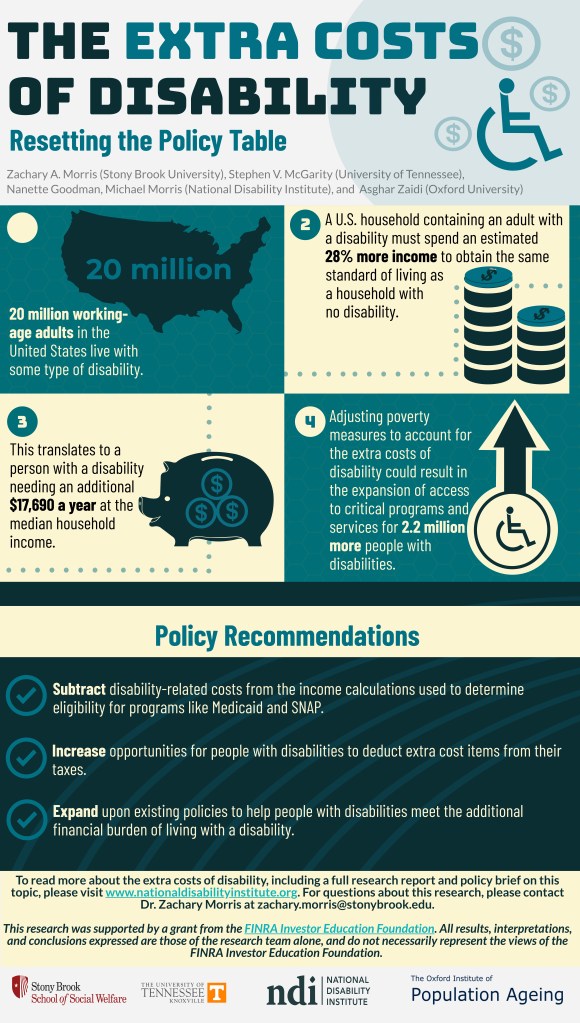
Researchers estimate that households containing an adult with a work-disability require, on average, 28 percent more income (or an additional $17,690 a year for a household at the median income level) to obtain the same standard of living as a comparable household without a member with a disability says the National Disability Institute.
And I currently do not work because part time jobs that are within my ability to accomplish are few and far between. It took me two years to get my last part time job.
The National Disability Institute set forth some good suggestions of policy changes that would allievate this strain on persons who are disabled and their families. (See their graphic below.)
All I can say to add to this is, I have phone calls to make.


Leave a Reply